Showing posts with label types of work injuries. Show all posts

Friday, August 19, 2016

Are Injured Undocumented Workers Eligible For Pennsylvania Workers' Compensation?

Yes.  To answer shortly.  Undocumented workers (or illegal aliens) are eligible for workers' compensation benefits when they are injured at work.  However, there are some issues that should be considered before an undocumented worker files a workers' compensation claim.

First, your undocumented status could be revealed during the litigation of your claim.  Eventually, the INS could possibly investigate and deport the worker.  Although this is unlikely, it is still a possibility.
 
Second, often wages are paid under the table and paid in cash.  Because of this, and the worker's undocumented status, many times these wages are not reported to the IRS.  Again, although it is unlikely, the IRS could investigate.
 
Third, the employer is less likely to bring you back to work after you recover from your work injury if he discovers during the litigation of your compensation claim that you are undocumented.  However, most likely the employer already knows your undocumented status before the work injury.  Further, if the injury is serious enough, you might not be able to return back to heavy labor work anyway.
 
The bottom line is that if you're an undocumented worker and are injured at work, before you do anything you should talk to an experienced workers' compensation lawyer.

Tuesday, May 7, 2013

New Cure for Back Pain??

Many of my clients suffer from back pain.  Whether it is caused by a work related injury or a car or truck accident or a fall in the grocery store, I see back injuries all the time with my clients.  So, when I read stuff (and I read a lot of stuff...) I'm always interested in medical research related to the injuries and conditions that affect my clients.  That's why I was very interested in this new report regarding new research in curing back pain.....from RawStory.com:

"Up to 40% of patients with chronic back pain could be cured with a course of antibiotics rather than surgery, in a medical breakthrough that one spinal surgeon says is worthy of a Nobel prize. Surgeons in the UK and elsewhere are reviewing how they treat patients with chronic back pain after scientists discovered that many of the worst cases were due to bacterial infections.

Specialists who deal with back pain have long known that infections are sometimes to blame, but these cases were thought to be exceptional. That thinking has been overturned by scientists at the University of Southern Denmark who found that 20% to 40% of chronic lower back pain was caused by bacterial infections.

“This will not help people with normal back pain, those with acute, or sub-acute pain – only those with chronic lower back pain,” Dr Hanne Albert, of the Danish research team, told the Guardian. “These are people who live a life on the edge because they are so handicapped with pain. We are returning them to a form of normality they would never have expected.”

In the first report, they explain how bacterial infections inside slipped discs can cause painful inflammation and tiny fractures in the surrounding vertebrae. Working with doctors in Birmingham, the Danish team examined tissue removed from patients for signs of infection. Nearly half tested positive, and of these, more than 80% carried bugs called Propionibacterium acnes.

The microbes are better known for causing acne. They lurk around hair roots and in the crevices in our teeth, but can get into the bloodstream during tooth brushing. Normally they cause no harm, but the situation may change when a person suffers a slipped disc. To heal the damage, the body grows small blood vessels into the disc. Rather than helping, though, they ferry bacteria inside, where they grow and cause serious inflammation and damage to neighbouring vertebrae that shows up on an MRI scan.

In the second paper, the scientists proved they could cure chronic back pain with a 100-day course of antibiotics. In a randomised trial, the drugs reduced pain in 80% of patients who had suffered for more than six months and had signs of damaged vertebra under MRI scans.  Albert stressed that antibiotics would not work for all back pain. Over-use of the drugs could lead to more antibiotic-resistant bacteria, which are already a major problem in hospitals. But she also warned that many patients will be having ineffective surgery instead of antibiotics that could alleviate their pain."

So, in summary, this potentially could be a huge help in curing chronic, long-lasting back pain.  It really is a fascinating read.  Take a look at the link above.

Thursday, November 29, 2012

Man hurt in workplace accident recovers more than $12M

A jury awarded more than $12 million to a man who claimed that he sustained brain damage in a workplace accident. The matter dates to June 16, 2007, when Victor Munoz fell off of a ladder while painting the exterior of a Manhattan hotel. 

He sustained fractures of a shoulder, his spine and several ribs, and he contended that he also sustained a brain injury that resulted in severe impairment of his balance and damage of his hearing and vision. 

Munoz sued the hotel's owner, operator and landlords. The defendants traded blame, but Judge Joan Madden deemed that all were liable. A jury awarded $12,320,856.69 to Munoz and $700,000 for his wife's derivative loss. The judgment will be paid by Munoz's employer, which was a third party to the suit.

You can see a full report on the case here at VerdictSearch.com.

Friday, November 16, 2012

Can you contract Parkinson's Disease from Work?

Many workers, particularly in plants and factories, use and are exposed to solvents.  These are a broad category of substances that are present in fuels, paints, glues, lubricants and cleaning products.  There was a recent study that has shown a strong link between long term occupational exposure to the solvent trichloroephylene and parkinson's disease.  

The study examined 6 specific solvents which were chosen for investigation because of past case reports of Parkinson Disease or Parkinson-like symptoms occurring in persons with exposure to one or more of these chemicals.  Parkinson Disease is a degenerative brain disease that causes tremors, movement problems, and dementia.  

This study is just one more bit of evidence that demonstrates employers should be extra cautious in teaching their employees how to handle these chemicals and protect themself from exposure, particularly long-term exposure.  

However, the researchers on the study voiced concerns about more than occupational exposure; their concerns about far reaching public health implications was due to the fact that trichloroephylene is the most frequently reported organic contaminant in ground water and is detectable in up to 30% of U.S. drinking water.  

If you want to read more about this and the study, click here.

Friday, April 20, 2012

Woman Injured During Sex On Business Trip Gets Workers' Compensation

I call that some good lawyering.....


An Australian female civil servant woncompensation for an injury sustained while having sex on a business trip, the Sydney Morning Herald reports.
The Australian Federal Court ruled the woman was entitled to compensation claim for facial and psychological injuries suffered when a light fixture fell off the wall and on top of her in a motel room bed where she was having sex with a male friend.
The woman, who remains anonymous to protect her identity, suffered injuries to her nose, mouth and a tooth from the glass light hitting her face, according to the BBC.
The incident, which took place in November 2007, reverses a previous lower court decision.
As an employee for Australia's Commonwealth Government agency, the woman's lawyer argued 
sex was an ordinary incident of life in a hotel room, reports NEWS.com.au.
Because the woman had been on a work trip, the judge made the decision to compensate her for the incident.
"If the applicant had been injured while playing a game of cards in her motel room, she would have been entitled to compensation," Justice John Nickolas said.

Monday, January 23, 2012

Women feel more pain than men

Because I represent injured people in workers' comp cases or auto accidents or other types of accidents like slip and falls, I deal with people in pain on a constant basis.  That's why this article from the NY Daily News jumped out at me.

Researchers at Stanford University examined medical records of more than 72,000 patients, and found that women reported feeling about 20 percent more pain than men. 
Patients were asked to rate their pain on a scale from 1 to 10, with 1 being no pain at all, and ten being the most extreme pain, and on average women reported one point higher than men. Their findings, which were published Monday in the Journal of Pain, held true for a wide variety of diagnoses. 
Scientists are studying whether the disparity proves that women actually feel more than men, or whether they're simply more willing to report feeling pain.

I'm not sure what I make of this.  Obviously, our culture stresses that boys and men, generally, should not complain of pain or be deemed "less manly."  I think that probably has a lot to do with it.  Anyway...fascinating stuff.  The entire article is a good read. 

Wednesday, August 24, 2011

More possible treatments for lumbar disc injuries

Surprisingly, the treatment doesn't involve surgery or spine manipulation or traction or any of the traditional treatments. It involves the use of adult stem cells to regenerate the damaged disc including the reversal of the degenerative process. Cool stuff...hope the clinical trial pans out. Here's a link to the article.

Monday, June 20, 2011

The Mystery of Chronic Pain

Many of my clients suffer from chronic pain. It is a costly--physically, emotionally and financially-- condition. I have attached a video from Dr. Elliot Krane who is an expert on chronic pain. It's a quick, fascinating explanation of chronic pain.


We think of pain as a symptom, but there are cases where the nervous system develops feedback loops and pain becomes a terrifying disease in itself. Starting with the story of a girl whose sprained wrist turned into a nightmare, Elliot Krane talks about the complex mystery of chronic pain, and reviews the facts we're just learning about how it works and how to treat it.

Thursday, January 20, 2011

Engineers injured in fall from collapsing stairs awarded $7.8M

In many workers' compensation cases, the work-related injury is caused by a another person or entity. In these types of cases (usually called "Third Party lawsuits) the injured worker can file a negligence claim against the person or entity that was at fault. Actually, many of my personal injury cases are really Third Party cases and have come to me originally as workers' compensation cases that I have determined were caused by someone else's negligence.

You may ask...why file a Third Party case when you have a valid workers' compensation claim? The main reason is that under Third Party negligence lawsuits, the plaintiff can seek pain and suffering damages. But under workers' compensation claims in Pennsylvania, the injured worker is only allowed to recover lost wages and medical bills.

The following case synopsis is an example of just such a Third Party case that was filed in Allegheny County, Pennsylvania and was provided to me via VerdictSearch.com:

Two engineers who fell from a collapsing staircase in a research plant recovered a $7.8 million verdict. Clifford Decker and David Gillingham were working on project for Consol Energy Inc. when an exterior steel staircase, the only exit from the building, suddenly collapsed and sent them falling 14 feet to the ground. Decker fractured his femur and hip and Gillingham suffered a torn rotator cuff and shoulder impingement. The plaintiffs claimed that the 40-year-old building wasn't properly inspected. Consol Energy argued that there was no notice of a problem with the staircase, which was used numerous times without incident and showed no signs of deterioration.

Decker v. Consol Energy Inc.

Friday, December 31, 2010

Doctors Getting Rich With Fusion Surgery Debunked by Studies

Many of my workers' compensation clients suffer from work-related back injuries. They range from simple pulled muscles and pinched nerves to full blown herniated discs to severed spinal cords causing a paralyzing condition. The treatment for these injuries can be as simple as rest to physical therapy all the way to serious spine surgery.

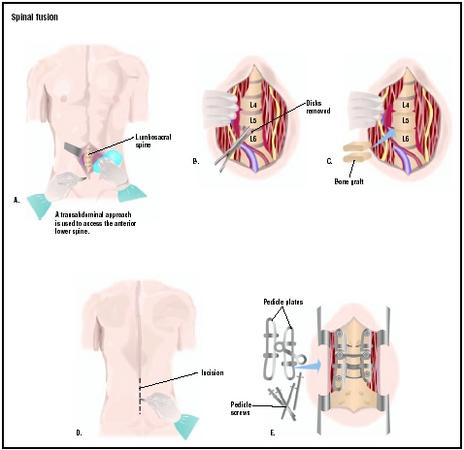
One of the types of spine surgeries that many of my clients have undergone is spinal fusion surgery. This surgery entails screwing together, with a metal cage, several vertebrae in the spine in order to limit painful movement in the vertebrae. Here is a picture of what a typical fusion surgery looks like:


I recently came across a Bloomburg article about fusion surgeries that was very disturbing. From the article, I learned that the number of fusions at U.S. hospitals doubled to 413,000 between 2002 and 2008, generating $34 billion in bills, data from the federal Healthcare Cost and Utilization Project show. The number of the surgeries will rise to 453,300 this year, according to Millennium Research Group of Toronto.

In and of itself, the rise in the number of fusion surgeries should not be a concern, assuming the procedure helps patients live productive, relatively pain free lives. But the studies say different.

It’s amazing how much evidence there is that fusions don’t work, yet surgeons do them anyway,” said Sohail Mirza, a spine surgeon who chairs the Department of Orthopaedics at Dartmouth Medical School in Hanover, New Hampshire. “The only one who isn’t benefitting from the equation is the patient.

The Evidence

British and Norwegian researchers found fusion no better than physical therapy for disc-related pain in three studies, totaling 473 patients, published in the journals Spine, Pain and the British Medical Journal between 2003 and 2006. A 2001 Swedish study of 294 patients in Spine found fusion better than physical therapy that was less structured than the kinds used in the other studies.

Rates of complications from surgery in three of the European studies -- including bleeding, blood clots, and infections -- were as high as 18 percent. None reported complications from physical therapy. The four studies are cited in journals as the only head-to-head, randomized comparisons between the two treatments.

In a U.S. study in Spine in 2007, surgeons reported fusion was successful in only 41 percent of 75 patients suffering from lower-back disc degeneration. Success measures included pain reduction. Two years earlier in the same journal, surgeons found a 47 percent success rate among 99 patients, 80 percent of which were taking narcotics for pain two years later. Both studies compared fusion to artificial disc replacement in trials submitted to the FDA.

The Blommburg article, from which this information was taken, is quite extensive and has many personal examples of how this surgery has not helped people, but ruined their lives. In my practice, I have seen both sides of this issue. I have clients who have undergone the surgery and have had a good result and I have had clients have a bad result and have to return to the surgical table and ultimately, be diagnosed with failed back syndrome.

If you are contemplating undergoing this type of surgery, please consider all of the factors. Also, always obtain a second opinion. If this is a Pennsylvania workers' compensation injury, you would have a right to a second opinion that the insurance company would have to pay for.

Thursday, December 2, 2010

Slip and Falls during bad weather

It's that time of year again. The weather gets cold and the ice and snow start to fall. Un-cleared sidewalks become mine fields of danger. So, please be careful where and how you walk on slippery sidewalks.

As you know, we handle slip and fall cases at C&C Law. Either innocent pedestrians or innocent workers who slip and fall on snow/ice while working. So, here's a reminder to property owners. Make sure your public sidewalks and walkways are clear. Or you just might be getting a call from me....and you don't want that headache....

Here's a funny video to remind you of the dangers of slippery sidewalks.....


Thursday, October 14, 2010

Two Cargill employees injured in Wyalusing Plant

As per the Towanda Daily Review:

Two Cargill employees suffered burns in an incident at Cargill around noon Wednesday in Wyalusing, Mike Martin, spokesman for the company, said.

He said two male maintenance employees were working on a pump in the tallow rendering plant. He declined to name them.

Carroll & Carroll, P.C. has handled a lot of workers' compensation cases against this plant over the years. I hope these workers' recover from their burns. And I hope Cargill doesn't try to attempt to bring these injured employees back to work too soon, as they often do.

Monday, August 31, 2009

The 5 Most Common Building Site and Construction Accidents

Many of our Pennsylvania workers' compensation clients are construction workers. In my years as a workers' compensation lawyer, I've seen just about every type of work injury there is to get on a construction or building site. This article explores some of the more common construction accidents in the workplace.

Ladders.

Ladders always carry a danger. When ladders are used to move between different levels on a construction site injury can be caused in a number of ways. One of the more serious injuries we have seen was when someone had failed to secure a ladder to the next level. As the user ascended the ladder it came away from the scaffolding causing him to fall over 30 feet to the floor, shattering his heel in the process.

Other injuries using ladders occur when someone is carrying equipment which is too heavy, causing them to fall away from the ladder, or when there is insufficient ladder protruding above the next level causing the user to miss their footing with nothing to hold onto.Falling Debris.

Another common cause of accidents is debris falling from a height landing on workers on lower levels or working on the ground levels. Depending on the item that is dropped (from wooden planks to brickwork) and the height it is falling these accidents can cause severe injuries.Falling From Heights.

Due the nature of a construction site many workers are working at several stories high. Roofers particularly are at risk from falling from a great height. If the fall is as a result of poorly constructed scaffolding or a defective roof you may be able to make a claim for compensation. This could also be the case if you have not been provided with the correct safety equipment or the right level and amount of training.

Machinery.

If you are using power tools on a construction site these can lead to injury either through defects in the machinery itself, inadequate training or failure to provide the correct safety equipment.

Trips and Slips.

Due to the amount of equipment on a construction site it is quite common for workers to slip or trip over discarded equipment or debris and suffer injury. This can be particularly hazourdous if the trip or slip leads the victim to fall into holes on the site. Trips and slips are a common hazard on a building site, and whilst each employee must take all necessary action to prevent injury, if the employer has failed to take the necessary steps you will be able to make a claim for compensation.Summary.

A construction site is a dangerous place to work, but your employer must do all that they can to keep you safe. If they fail to discharge their duty to protect you and you suffer injury, you can make a claim for compensation for your pain and suffering, loss of earnings and any other expenses.

Thanks to Nick Jervis for this information. You can read more about being Injured At Work? Find out more about Work Accidents generally and read our Free Work Accident Claims Guide. Nick Jervis is a solicitor (non-practising) and a consultant to Work Accident Solicitors who specialise in Work Accident Claims.

Monday, June 15, 2009

Acupuncture may help reduce back pain, research finds

A vast majority of our workers' compensation cases at Carroll & Carroll, P.C. involve clients who have suffered a back injury. Over the years of practicing workers' compensation law, the alternative medical procedure of "acupuncture" has gradually gained prominence.

I remember the early days when acupuncture was considered a bogus procedure. Now, most insurance companies will pay for acupuncture treatment.

A new study appears to show that acupuncture can be an effective treatment for chronic back pain with sufferers reporting a 20% reduction in pain.

Attached is a link to a telegraph article on the study.

Monday, June 8, 2009

Cell Phone Elbow

Just in case you haven't heard of the new condition, it's called cell phone elbow or, more commonly referred to in medical terms as "cubital tunnel syndrome."

Here's a story about it from CBS News.

"The latest over use or repetitive motion injury to join the digital age list is cell phone elbow. It is caused by too much bending of your arm to put a cell phone to your ear. This bending compresses the ulnar nerve, which runs along the bony bump on the inside of the elbow."

I have seen many "cubital tunnel" cases in my practice, but none using the theory of too much cell phone use. However, I can see how this might easily be a winnable case. In my own experience of holding a cell phone while driving (before I purchased a "hands free" unit) it would only take about 5 to 10 minutes before my arm became sore.

Friday, April 24, 2009

Some of our successful case results

Please note that every case is different and these workers' compensation lump sum settlements, while accurate, do not represent what we may obtain for you in your case. Every injured worker is different given the type of injury, the amount of disability, your average weekly wage and weekly compensation benefit rate.

Nor does it mean that we win all of our cases - we don't. Our clients tell us that knowing that we have achieved significant results is one factor that many of them used to decide to hire us. You certainly should ask any prospective attorney whether he or she has obtained significant verdicts and lump sum or compromise and release settlements but the decision to hire an attorney should not be made on this factor alone. We would be more than happy to discuss any of these cases, and many others, with you.

Bridge Construction worker with herniated discs in neck - $385,000.00

43 year old male who was a highly paid bridge construction worker injured his neck while lifting on the job. He ultimately had to undergo two cervical surgeries to repair herniated discs in his neck. Thereafter, he developed RSD or Complex Regional Pain Syndrome in his left arm. He ultimately lost the use of his left arm for every, practical uses. He also started experiencing the same symptoms in his right arm, all stemming from the neck injury.Carroll & Carroll, P.C. filed litigation. The insurance company accepted responsibility for the work injury and even agreed that the claimant lost the use of his left arm. However, the workers' compensation insurance company disputed the relatedness of the right arm.The case settled for $385,000.00 which is a record settlement for Carroll & Carroll, P.C. in a workers' compensation case. Also part of the settlement is that the insurance company has agreed to pay whatever medicare set aside amount is required by Medicare.

Repatative Use Injury to Arms - $175,000.00

53 year old woman had worked at a label making plant for over 20 years. Several years ago, she began having pain in her right arm when she would perform her highly repetitive duties making labels for clothing. When she was restricted to one arm work, she had to use her "good" arm too much and began suffering the same symptoms in the left arm. Carroll & Carroll, P.C. filed a claim petition against the employer and won the case. The workers' compensation judge ruled that the claimant first suffered a right arm epicondylitis and then, due to over-use, suffered the same condition in her left arm later in her employment. An interesting twist in this case was that each "arm injury" was covered by a different insurance company due to the time the injuries arose.

Eventually, Carroll & Carroll, P.C. was able to secure a settlement for the claimant that protected her future medical bills and allowed her to retire with no financial worries.

Loss of use of arm for lumber yard worker - $150,000.00

27 year old male who was working at a local lumber yard injured his arm on a piece of the industrial machinery used to plane wood. While clearing out pieces of debris from the machine, another employee turned it on, locking the client's arm in the machine and causing injury. The client's arm was significantly injured, needing many surgeries.Carroll & Carroll, P.C. filed a petition to force the workers' compensation insurance company to pay the client specific loss benefits. These are benefits an injured employee receives when he/she loses the use of a body part. We argued that the client lost the use of his arm due to the injury. We eventually settled the case for a lump sum payment of $150,000.00. Also, the client is on social security disability. Carroll & Carroll, P.C. has also filed a product liability lawsuit against the manufacturer of the machine due to it being defective for not having proper safeguards designed into the machine.

Construction worker broke leg requiring surgery - $145,000.00

While on a job site, a 45 year old construction worker tripped over some boards, breaking his leg. The break was so bad that surgery had to be done to place screws and plates to mend the bones. Unfortuneately, the client's leg was so disabled that he could not return to construction work. Further, the client developed RSD or what is now referred to as Complex Regional Pain Syndrome. Carroll & Carroll, P.C. was able to win the client's comp benefits after the insurance company denied him what was owed to him. Further, we were able to secure Social Security Disability benefits for the client, then settle his workers' compensation claim for $145,000.00. After the comp settlement, the client will continue to receive his monthly SSD check plus have all of his medical bills paid for through Medicare.

Shop Teacher Amputates Fingers on Table Saw - $125,000.00

A Vocational Tech teacher for a local school severely injured his hand while using a table saw in shop class. Even though the teacher returned to work after a brief period, Carroll & Carroll, P.C. filed a claim for the "specific loss" of use of several fingers. We were able to prove that the teacher had loss the use of three fingers either through outright amputation or severe damage. The case was ultimately settled for a lump sum of $125,000.00 including the payment of all medical bills and the waiver of the workers' compensation lien against any recovery from the product liability case against the table saw manufacturer.

Lumbar Surgery - $110,000.00

38 year old male injured his lower back while lifting something heavy at work. He eventually had lumbar spine surgery and was totally disabled. He had been on workers' compensation for many years before coming to Carroll & Carroll, P.C. for help in getting some medical bills paid. We made sure he was approved for Social Security Disability and Medicare. Then we settled his workers' compensation case for $110,000.00. Now the claimant does not have to worry about his benefits being cut off or looking over his shoulder all the time worrying that someone was watching him. He did not have to go to hearings anymore and could move on with his life.

Loss of Use of Hand - $110,000.00

60 year old woman had her hand trapped in a conveyor belt while working at a local cabinet making plant. After several surgeries on her hand and a partial amputation of her index finger, she no longer had much use of the hand. The lawyers at C&C Law filed a petition for specific loss of use of her hand. We put on such a good case that we were able to settle her case for a $110,000.00 lump sum payment plus continued medical coverage for 2 years.

Blister On Foot Nets Big Comp Settlement - $90,000.00

45 year old male who injured his foot at work causing swelling. Because he continued to keep working with the swelled foot, a blister appeared due to his tight fitting shoe. Unfortunately, the blister became infected with MSR. The employee went through many surgeries and loss of a few toes due to the infection. Complicating matters was the fact that the employee had pre-existing diabetes that was obviously not related to work and that contributed to the infection not healing. So, the insurance company argued that the employee's current condition was not related to the original work injury but to his diabetes.

Carroll & Carroll, P.C. filed a Specific Loss petition claiming that due to the many surgeries and infection and loss of a few toes, the claimant had loss the use of his entire foot as if it was actually amputated. Also, there was a question as to jurisdiction of the case. The insurance company wanted to have the case heard in either Maryland (where the original foot injury occurred) or New Jersey (where the employer's corporate headquarters was located) or in New York (where claimant lived), three states that are not as good for injured workers as Pennsylvania. We were able to negotiate with the insurance company to have the case heard in Pennsylvania. Also, we were able to get all of the medical bills paid. Further, we were able to convince the insurance company that the claimant actually loss the use of his foot. The case was settled for a lump sum of $90,000.00. Also, the claimant was approved for Social Security Disability so he will be receiving monthly benefits in order to pay his living expenses. Further, he was approved for medicare so his future medical bills will be paid.

Work related back injury but no surgery - $80,000.00

A 26 year old man injured his back lifting something heavy while working at Proctor and Gamble in Meshoppen, Pennsylvania. The client was off work due to his injuries despite the fact that P&G wanted him to come back to work on light duty. The client did not have surgery on his lumbar spine.

Wednesday, March 11, 2009

No Work Jobs

Every once in awhile I have a case where the employer offers a sedentary job to one of my clients but the job is really not a “job.” It is referred to as a “no work” job where the claimant merely shows up and sits there and basically does nothing. But, the injured worker gets paid his normal wage for his time.

You may ask why would an employer do this, basically pay someone their normal wage for producing no work? In many instances there are unseen costs of having the employee out of work and receiving workers’ compensation wage benefits. Some employers want to keep the employee at the job site so they can keep an eye on him/her. Some employers think it is too expensive to have a wage claim open with their insurance company because their workers’ compensation premiums will rise. Other employers merely want to set the employee up for failure so that they can fire the employee and stop his workers’ compensation benefits.

In a new case from the Commonwealth Court of Pennsylvania, Channel Lock, Inc. v. W.C.A.B. (Reynolds), the Court addressed one of these “no work” jobs. The court ultimately held that the job was not within the injured employee's physical capabilities.

The facts are pretty simple. The injured employee was offered a job where he basically came in to work and sat there. The employee actually tried to do this but fell asleep one day because the medication that he was taking made him drowsy. The employer threatened to fire him if he did it again. At that point, the employee’s attorney filed a petition to allege that the job was not available within his physical restrictions. During the hearing process, the claimant’s doctor testified that the medication could cause drowsiness and the claimant himself testified that every time he took this prescribed medication he became sleepy.

Ultimately, the Commonwealth Court held that the job was not within the claimants physical restrictions due to the fact that he could easily fall asleep while performing these “no work” jobs.

I believe that the underlying lesson in this case is that the courts do not look kindly on these “no work” jobs and, if possible, will always rule on the side of the claimant if they believe that there are other motives that the employer has offered these sham jobs.

Tuesday, September 9, 2008

New procedure as alternative to lumbar fusion surgery

Many of our clients suffer from back injuries and symptoms emanating from their spine. Also, many of our clients treated at the Southern New York Neurosurgical Group, specifically by Dr. Bajwa or Dr. Sethi.

I just noticed an ad in a free health magazine from Dr. Bajwa and Dr. Sethi requesting patients to be enrolled in a new study. The doctors are conducting an investigational research trial with a surgically implanted motion restoring device that replaces the facet joints of the spine as an alternative to fusion surgery.

They are asking for anyone to contact them that has experienced chronic leg pain with or without back pain, have been diagnosed with spinal stenosis and are considering surgery as a treatment option. The participants must be between 50 and 85 years of age and can not have a history of fusion surgery of the lumbar spine.

People who are interested are urged to call the Southern New York Neurosurgical Group at (607) 754-6247

Monday, August 4, 2008

New case law on allowing total disability benefits even when the injured employee is back to work

In Allegheny Power Service Corp. v. WCAB, the Pennsylvania Commonwealth Court ruled that the WCAB has discretion under the Workers' Compensation Act to award total disability benefits even when an injured worker is able to return to a job and earn wages.

In 1995, the injured worker suffered severe electrical burns when he came in contact with a charged electrical line. His right arm was amputated at the elbow and his left hand was badly damaged to the point of being almost useless.

The claimant eventually returned to light duty work at his normal wages so the insurance company stopped his total disability wage benefits. Claimant's counsel, though, filed a penalty petition contending that under Section 306(c)(23), Claimant should continue to receive total disability wage benefits despite him returning the work.

The workers' compensation judge determined that the matter was governed by section 306(c)(23) of the Workers’ Compensation Act (Act), which creates a statutory presumption of total disability for individuals who suffer specified bilateral losses: “Unless the board shall otherwise determine, the loss of both hands or both arms or both feet or both legs or both eyes shall constitute total disability, to be compensated according to the provisions of [section 306(a) of the Act, 77 P.S. §511].” 77 P.S. §513(23) (emphasis added).

On appeal, the Employer argued that the WCAB erred in interpreting section 306(c)(23) of the Act as mandating an award of total disability benefits without regard to evidence of Claimant’s post-injury earning power. Specifically, the Employer argued that, because awards under section 306(a) are premised upon a loss of earning power, the principle that specific loss benefits are payable without regard to a claimant’s earning power is not applicable to awards under section 306(c)(23). The Commonwealth Court disagreed.

The Court held that a claimant who sustains an injury adjudged compensable under section 306(c) (specific loss) is not entitled to compensation beyond that provided by section 306(c), even though he may be totally disabled by his injury. Killian v. Heintz Div. Kelsey Hayes, 468 Pa. 200, 360 A.2d 620 (1976). It always has been recognized that the right to compensation under section 306(c) is measured by the extent of the injury, regardless of the degree of disability. Morrow v. James S. Murray & Sons, 7 A.2d 109 (Pa. Super. 1939).

In cases where there is a bi-lateral loss, the claimant's future earning power should not be considered. Also, the sole discretion lies with the WCAB and cannot be overturned on appeal. Thus, if the WCAB determined, as it did in this case, that the claimant should receive ongoing total disability benefits, despite working, then the appellate courts cannot overturn that decision.

Wednesday, July 23, 2008

U.S. Rushes to Change Workplace Toxin Rules

Once again, the Bush Administration doing everything it can to help Big Business and hurt workers.

Political appointees at the Department of Labor are moving with unusual speed to push through in the final months of the Bush administration a rule making it tougher to regulate workers' on-the-job exposure to chemicals and toxins.

The text of the proposed rule has not been made public, but according to sources briefed on the change and to an early draft obtained by The Washington Post, it would call for reexamining the methods used to measure risks posed by workplace exposure to toxins. The change would address long-standing complaints from businesses that the government overestimates the risk posed by job exposure to chemicals.

The rule would also require the agency to take an extra step before setting new limits on chemicals in the workplace by allowing an additional round of challenges to agency risk assessments.

You got that? They want to make it harder to protect workers from toxic exposure at work. See the full article here.